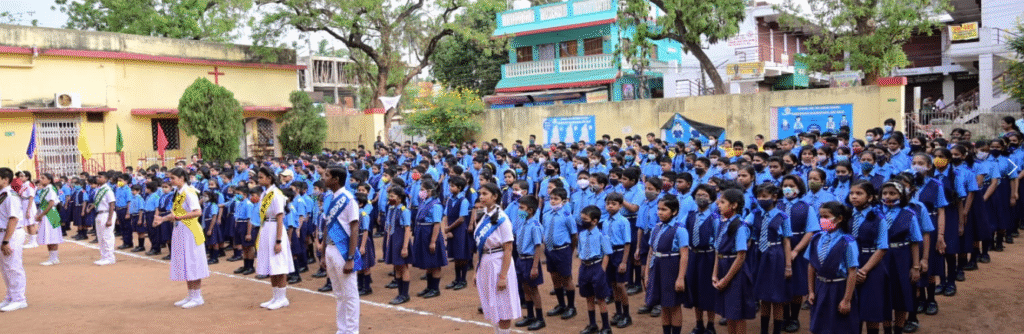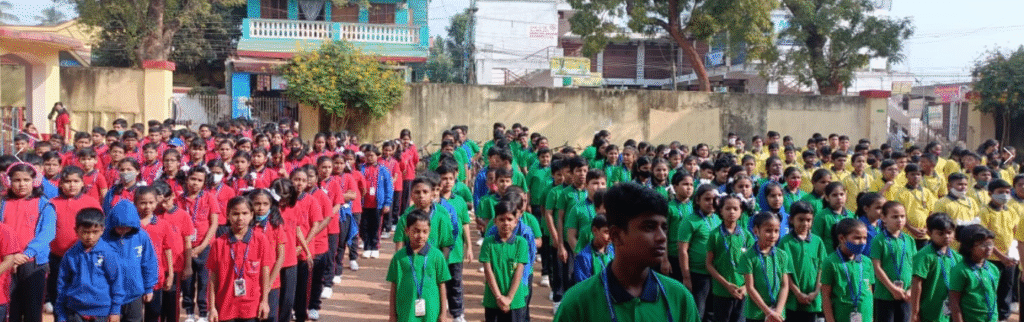
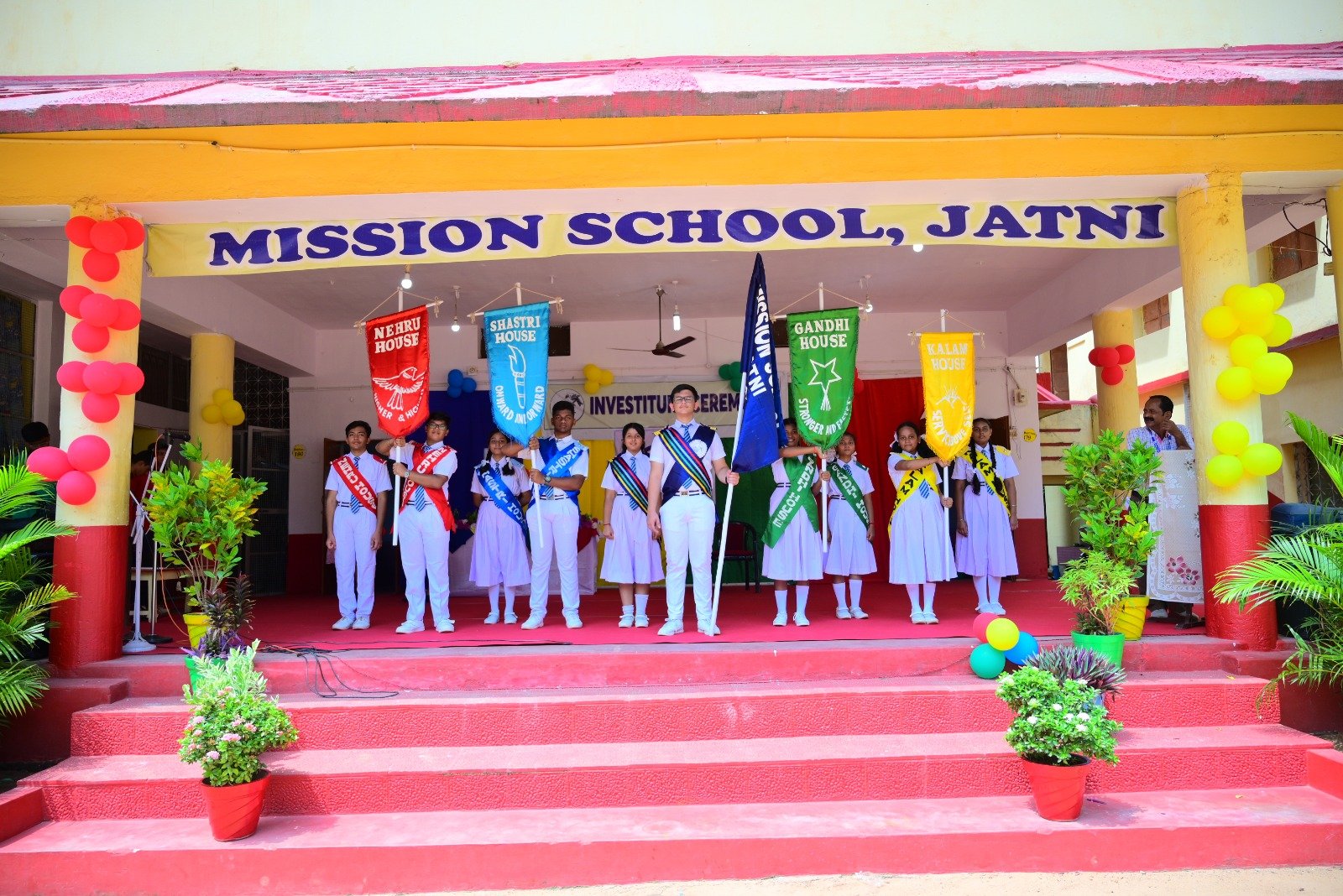
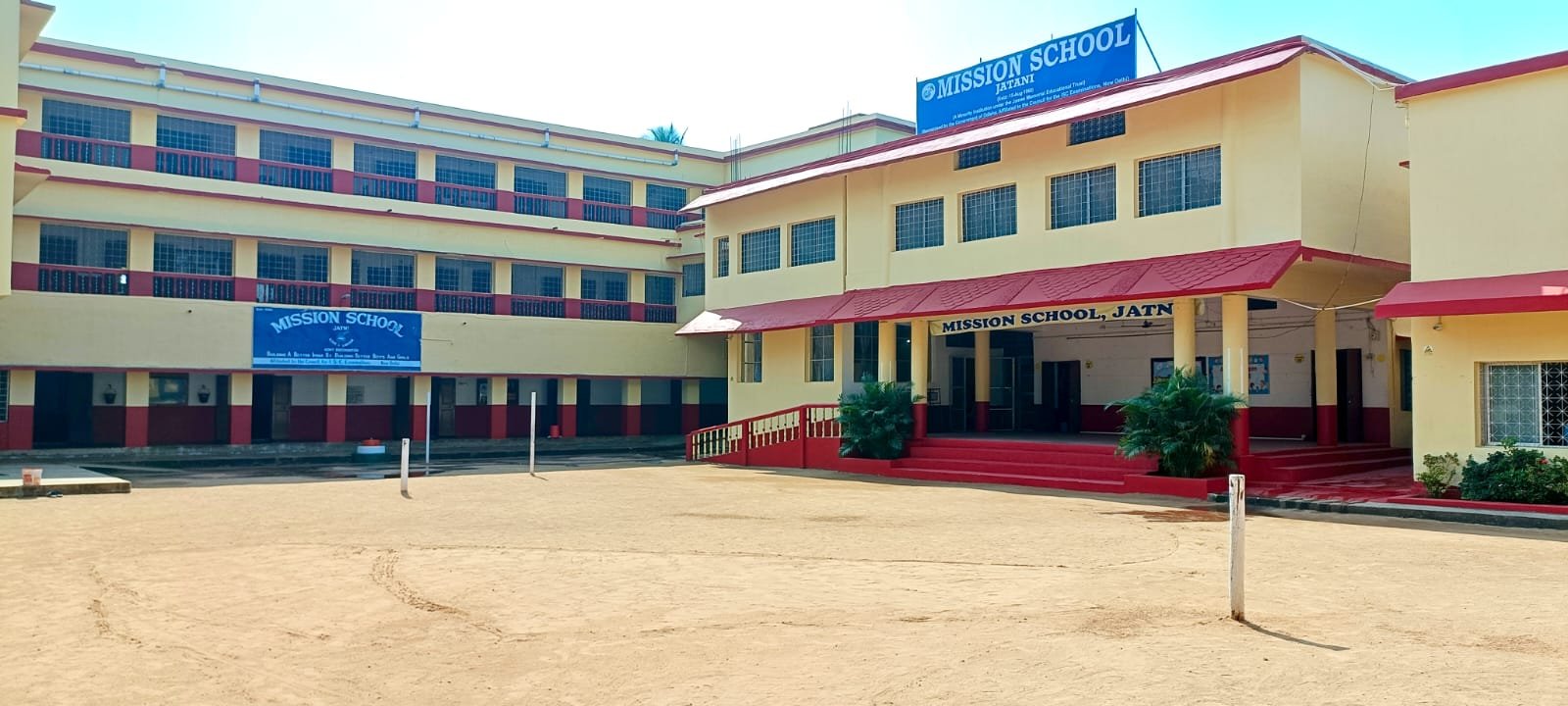
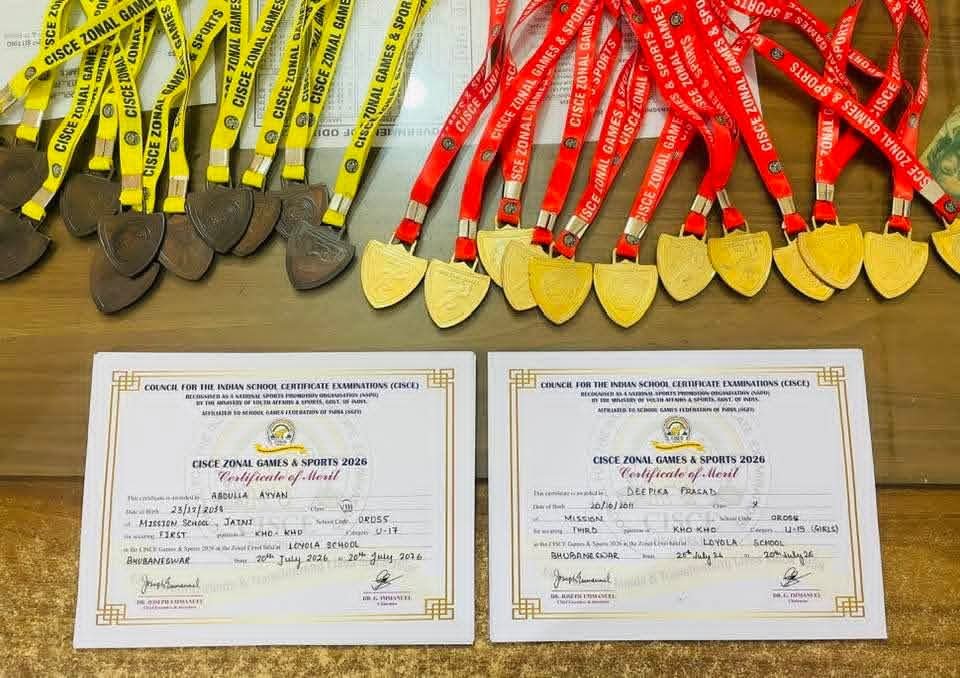
Welcome to Mission School Jatni, the leading ICSE-affiliated school in the heart of Jatni, Odisha. We are committed to delivering high-quality education rooted in discipline, moral values, and academic excellence. Since our inception, Mission School has been more than just a school — it’s a nurturing ground where young minds are inspired, talents are discovered, and future leaders are shaped.
Our school provides a well-balanced, holistic learning experience that goes beyond textbooks. With a focus on intellectual growth, character building, and co-curricular development, we aim to prepare students not just for exams — but for life.
To be a leading institution that inspires innovation, integrity, and a passion for learning. Mission School envisions a future where every student reaches their full potential.
To provide quality education that nurtures academic excellence, character, and lifelong learning. We are committed to shaping responsible citizens through holistic development.

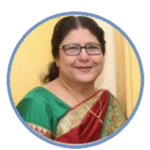
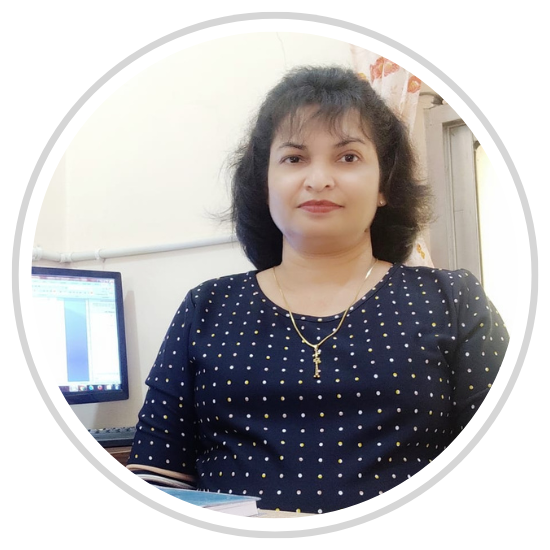
(Headmistress )
During a life time of teaching in Mission School, spanning 50 years. Our Headmistress, Mrs. Arline D’souza is loved by the Staff, Students and Parents alike and has received rich tributes and messages of appreciation. Her deep love for teaching is epitomised in the completion of 50 years of service in Mission School Jatani, which has qualified her among a small number of Teachers and Administrators to complete a Teaching Career spanning 50 years and one of the few in the Country to have done so at the same School. Her sensitivity to those who need help, her pleasant and helpful manners, excellent teaching capabilities and her commitment to passing on the highest standards to Students and Staff are among her fine qualities It’s a pleasure to see her face light up whenever she meets former students. She also has a great rapport with Parents. A quality to be admired in her is her insight into the minds of Students and Teachers. She can recognise immediately the dodger, the worker, the effort maker Lovely qualities and a great advantage for a Headmistress
To us, Teachers and Office Staff, she has been a wonderful Administrator Leader and Friend She is everything one could look for in a good mentor She groomed us to be sound professionals and made working with her an interesting and memorable experience. We will always be grateful to her for her support and kindness towards us “Thank you ,Ma’am” for being such a great role model, for opening our eyes to new vistas of opportunity and strength. Your perseverance, integrity and loving nature are just a few of your qualities that continue to inspire us. We have learned from you the values of tolerance, patience and dedication. From weakness to strength, from grass to grace, the knowledge you have imparted to us will be a great asset throughout our careers. You are an icon of sincerity and devotion, as well as a great philanthropist May God continue to shower his blessings on you and may you enjoy many more years of contentment and fulfilment May His peace always surround you.

Rev. (Mrs.) Sophia Mackertich, Founder-Pastorof Bethel Chapel, Khurda Road for nearly forty yearswas called to glory on the 1" October, 1991. Born onthe 13th December, 1905 young Sophia came to Indiain 1929 from Iran, where she had lost her husband, and had a vision of Christ, beckoning her to comeupto Him, in her time of deep sorrow. At Calcutta, she worked as an Armenian teacher in the LaMartiniere Girls School where she came into contactwith a godly Armenian lady who led her to a personalcommitment to Jesus Christ.

She always said, "It is better to be faithful thanto be famous." And she lived true to her calling to servesacrificially at Bethel Chapel, never depending on theChurch, but with her son's support. She preached onthe very last Sunday before her home-going on Hebrews Chapter II and kept up her fasting everyweek-end to the last one.



The CISCE has a long-standing legacy of providing high-quality education through its affiliated schools, which have maintained traditional values and high standards for over a century. Emphasizing English as the foundational language of communication, the CISCE fosters strong linguistic skills that are essential for success on the global stage, aligning with its vision of global excellence in education.
The ICSE curriculum integrates diverse literary and language activities, which sharpen critical thinking and expression. This well-rounded preparation gives ICSE students an edge when facing language proficiency tests or pursuing education abroad. In summary, its structured approach to English makes the ICSE syllabus a valuable choice for learners aiming to excel in global academic challenges.The ICSE syllabus is constantly revised according to the continuously evolving global changes in educational trends.ICSE offers a wide choice of alternative subjects and includes a detailed study of all subjects that is offered at the secondary level of examination.The detailed study of every subject gives an in-depth knowledge of the content and fosters qualities of diligence and perseverance amongst the students.The Assessment and evaluation methods examine and assess a student’s inherent abilities and aptitude with an encouragement to an original flow of thoughts and ideas.
This Minority institution was founded by the Late Rev.(Mrs.) Sophie Mack in the year 1960 under the Assemblies of God of North India. The School is recognised by the State Government and is affiliated to the Council for the ISC Examinations, New Delhi. The administration of Mission School is now under the Management of the James Memoral Educational Trust. Preference for Admission is given to deserving students from the Christian Minority Community and Anglo Indians. The School is run on Christian principles and offers to students,irrespective of
community and creed, a complete education of body, mind and spirit. The aim of the School is to build a better India by building better boys and girls.
The Council has been so constituted as to secure suitable representation of: Government of India, State Governments/Union Territories in which there are Schools affiliated to the Council, the Inter-State Board for Anglo-Indian Education, the Association of Indian Universities, the Association of Heads of Anglo-Indian Schools, the Indian Public Schools’ Conference, the Association of Schools for the ISC Examination and members co-opted by the Executive Committee of the Council.
The Council for the Indian School Certificate Examinations conducts three examinations, namely, the Indian Certificate of Secondary Education (ICSE –Class X); The Indian School Certificate (ISC – ClassXII) and the Certificate in Vocational Education (CVE – Year 12). The subject choices and syllabuses prescribed for these examinations are varied and aimed at nurturing the unique gifts of individual pupils
The Council is prepared to give special consideration and make necessary arrangements in respect of candidates who are handicapped in any way, which might affect their performance in the ICSE (X) / ISC (XII) Examination.
Special Difficulty Procedure
Disability, illness or other misfortune: When a candidate suffers some injury or bereavement or dire unforeseen circumstance which may adversely affect his or her performance in the examination, the Special Difficulty procedure is used. A form is forwarded to the Council by the Head of the candidates’ school and the candidates’ examination answer script is then given special consideration by a committee before the issue of the results. The Council’s committee does not give a “blanket” concession but treats every case on its merit, for experience has shown that candidates working under similar unusual stress are affected in widely different ways. For this reason the Special Difficulty Form provides for the performance of the affected candidate to be compared with that of his/her other classmates.
Divisions – I.C.S.E. (Class X)
INDIAN CERTIFICATE OF SECONDARY EDUCATION EXAMINATION
The Indian Certificate of Secondary Education Examination has been designed to provide an examination in a course of general education, in accordance with the recommendations of the New Education Policy 1986, through the medium of English.
The Indian Certificate of Secondary Education Examination will ensure a general education without any diversification of studies as all candidates are required to enter and sit for six subjects and Socially Useful Productive Work.
The Indian Certificate of Secondary Education Examination is a school examination and the standard of the examination pre-supposes a school course of ten years duration (Classes I-X).
Private candidates are not permitted to appear for the examination.
Depending on the nature and degree of the Special Difficulty the Council is prepared to make special arrangements, subject to the Convener concerned being convinced of the need and being able to provide the necessary facilities, and if the candidate accepts the responsibility for any additional expenses which may be incurred. The following special arrangements are the most common, either singly or in various combinations:
In 1952, an All India Certificate Examinations Conference was held under the Chairmanship of Maulana Abul Kalam Azad, Minister for Education. The main purpose of the Conference was to consider the replacement of the overseas Cambridge School Certificate Examination by an All India Examination. This set the agenda for the establishment of the Council.
In October 1956 at the meeting of the Inter-State Board for Anglo-Indian Education, a proposal was adopted for the setting up of an Indian Council to administer the University of Cambridge, Local Examinations Syndicate’s Examination in India and, to advise the Syndicate on the best way to adapt its examination to the needs of the country. The inaugural meeting of the Council was held on 3rd November, 1958.
In December 1967, the Council was registered as a Society under the Societies Registration Act, 1860.
In 1973, the Council was listed in the Delhi School Education Act 1973, as a body conducting “public” examinations.
The Indian Certificate of Secondary Education has been designed to provide an examination in a course of general education, in accordance with the recommendations of the New Education Policy 1986, through the medium of English. Private candidates are not permitted to appear for this examination.
[For more details see Regulations and Syllabuses booklet]